
Our Proficiency Levels
Berlitz Levels and CEFR levels
Berlitz Proficiency Levels and the European Reference Framework
At the start of every language course, we assess your current level of proficiency. We discuss your goals and the language level you are aiming to reach.
The widely used Council of Europe’s Common European Reference Framework for Languages (CEFR) defines different levels of language proficiency to make the evaluation of language skills more transparent and easier to compare. The CEFR levels reach from A1 for absolute beginners to C2 which is equal to the proficiency level of native speakers.
The Berlitz Levels
The ten Berlitz levels correspond to these CEFR proficiency levels. The following overview can help you find the corresponding level for your proficiency. Unsure which level you currently have? Then take our free placement test.
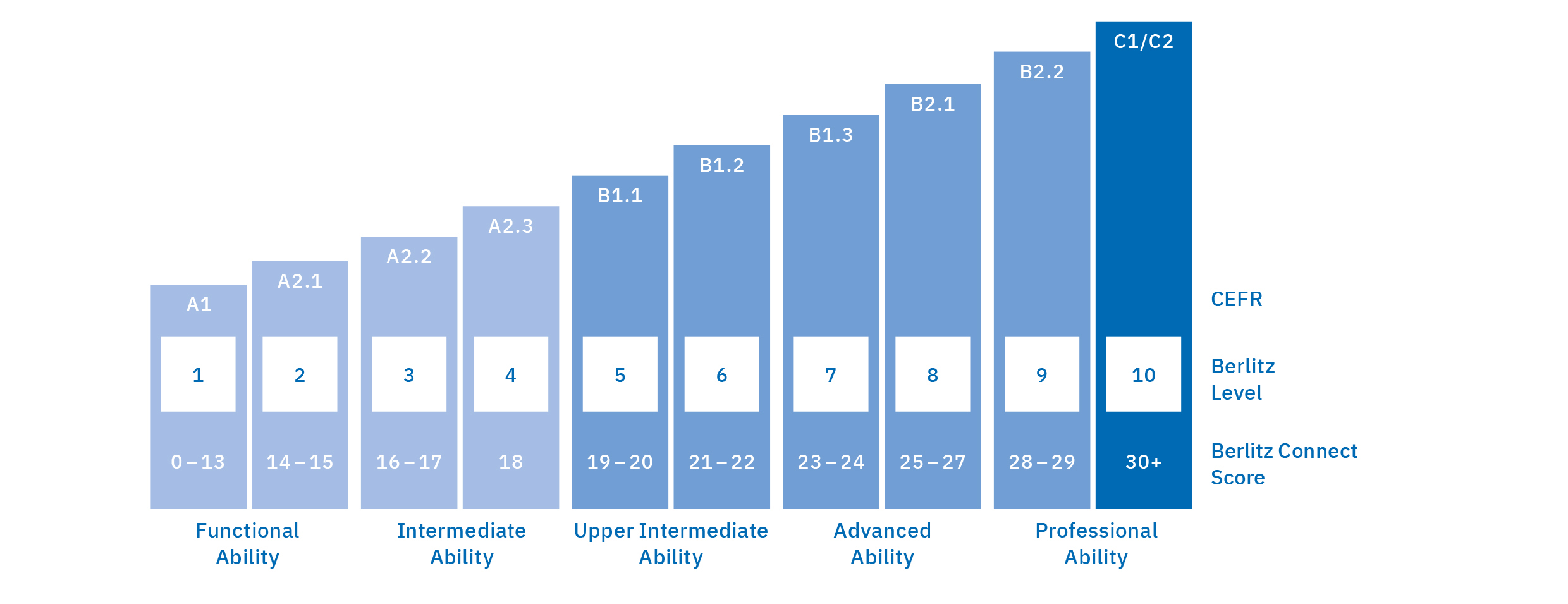
You can introduce yourself and ask other people simple questions about themselves – for example, where they live, how they are or what things they like and you can also give your own answers to these types of questions. You can take part in a simple conversation if the person you are conversing with talks slowly and helps you by repeating things.
You are able to understand and communicate general, simple messages. You can cope with information that is expressed clearly, and hold simple conversations. You are able to describe daily activities at home and at work using a range of simple expressions and sentences. You can ask for and understand information relating to daily activities, such as shopping or booking a holiday or hotel.
You can understand the general essence of a conversation on familiar topics, both in social and business situations. You can initiate, maintain and end a conversation. You are able to take part in simple discussions, give simple professional instructions, highlight a problem and present a solution. You can express congratulations, agreement or rejection or make complaints.
You are able to understand information on familiar topics in the relevant context and to hold a conversation about general topics. You are able to make professional contacts, give your advice and make suggestions. You can carry out more complex activities, such as exchanging goods or cancelling orders. You can write notes, messages and personal letters, for instance, to say thank you for something.
You can hold conversations on a range of situations and topics. You can explain or describe things in context. You can ask and respond to questions in the workplace. You find it easy to give general instructions for work processes. You feel comfortable in familiar situations with people or in a professional environment. You can discuss the quality of a product or a service, for example.
You can communicate competently and effortlessly in many professional and personal situations, and can find different ways of expressing the same thing. You can deal with a variety of topics in the appropriate manner. You can easily take part in conversations with several native speakers. You can discuss a project and express suggestions, opinions or ideas, for example. You can conduct long telephone conversations or make travel arrangements effortlessly.
You can express different points of view and can defend your ideas in a discussion. You can understand native speakers' proverbs. You are able to master challenging situations or, for example, settle any differences of opinion. You use the correct vocabulary and can cope in the majority of professional situations. You can give presentations, summarize facts and also use the given language in complex situations.
You can communicate efficiently and correctly in challenging activities and situations. You can effortlessly take part in all conversations in a social and professional environment. You are, for instance, able to give a professional presentation in a meeting or a sales presentation. You can express yourself with ease using different nuances and can also understand speeches on challenging topics well.
You can communicate efficiently with various audiences on a wide range of familiar and new topics and fulfill all language requirements whilst doing so. You take part in discussions and meetings confidently and competently, can express different points of view and can defend your ideas. You use correct, detailed expressions. You write all texts, such as emails or business letters, without any errors.
CEFR Level C1: You can express yourself spontaneously and fluently, without searching for words. You understand challenging texts effortlessly and can grasp complex terms and connotations. You can use and implement the language effectively and flexibly in your social and professional life. You express yourself clearly, in a structured manner and in detail with regard to complex and difficult matters.
CEFR Level C2: You understand everything that you read or hear, effortlessly. You express yourself very spontaneously, fluently and accurately. You make subtle nuances of meaning clear even in complex circumstances. You can produce challenging reports, articles or specialist texts. Your language skills largely correspond to those of an educated native speaker.

Berlitz Levels for Kids und Teens: IDEAL
For kids and teens, we use a dedicated language level system: Inspire, Discover, Explore, Achieve and Lead – or in short: IDEAL. This is used to assess the language students, to show them where they are currently at – and what they will be able to reach with Berlitz.
Find out more
Contact us today with your questions. Your Berlitz team will contact you shortly.